
News surfaced late last week that United States President Trump held a meeting with members of his administration and the emerging legal cannabis industry, during which he reportedly expressed a desire to reschedule cannabis from its current Schedule 1 status to Schedule III.
“President Donald Trump is expected to push the government to dramatically loosen federal restrictions on marijuana, reducing oversight of the plant and its derivatives to the same level as some common prescription painkillers and other drugs, according to six people familiar with the discussions.” reported the Washington Post late last week.
More details have since surfaced about who participated in the meeting. President Trump was joined in the Oval Office by Health Secretary Robert F. Kennedy Jr., Centers for Medicare and Medicaid Services chief Mehmet Oz, Heidi Overton from the Domestic Policy Council, Chief of Staff Susie Wiles, and Food and Drug Administration head Marty Makary.
Additionally, Mar-a-Lago club member Howard Kessler, an advocate for Medicare coverage of CBD, Trulieve’s Kim Rivers, and Jim Hagedorn from ScottsMiracle-Gro were also reportedly in attendance. Part of the meeting also involved a call to U.S. House Speaker Mike Johnson.
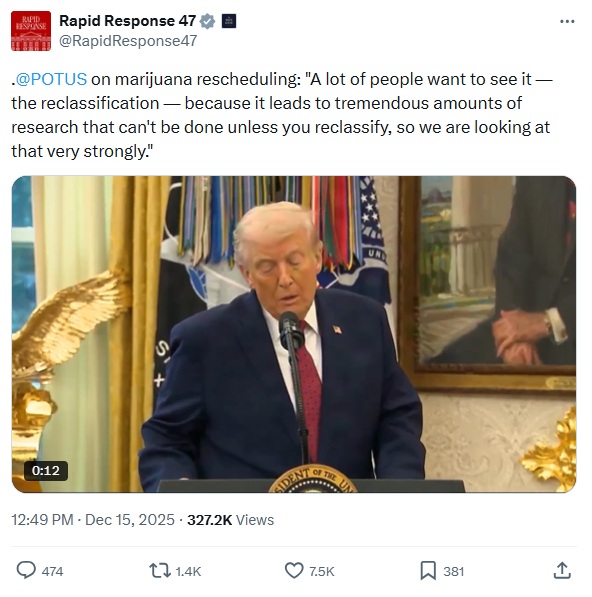
Since the reports surfaced, rumors have swirled as to when an official announcement for rescheduling would occur. President Trump weighed in on the topic when asked about it by the media yesterday.
Cannabis has been listed as a Schedule I substance at the federal level in the United States since the enactment of the Controlled Substances Act in the 1970s. Schedule I substances, which include heroin, are described as “drugs with no currently accepted medical use and a high potential for abuse.”
Conversely, Schedule III substances are described by the DEA’s website as “drugs with a low potential for abuse and low risk of dependence.” Examples of substances currently listed as Schedule III include Xanax, Soma, Darvon, Darvocet, Valium, Ativan, Talwin, Ambien, and Tramadol.
In a more ideal scenario, cannabis would be completely descheduled. After all, tobacco and alcohol are not on the federal schedule of controlled substances in the U.S., and the same should be true for cannabis. With that being said, the political reality is that cannabis being rescheduled is a much more likely outcome compared to it being completely descheduled, and members of the cannabis industry would be wise to anticipate it.
That anticipation should not just be limited to members of the cannabis industry in the United States. Rescheduling in the U.S. would no doubt have a ripple effect internationally in several ways, particularly in Europe, where the emerging cannabis industry is growing in size and scope with every passing year, and there is increasing cross-Atlantic collaboration between companies.
One of the most immediate impacts on the U.S. cannabis industry will come in the form of federal taxes on cannabis businesses. Many state-legal cannabis businesses in the U.S. pay a considerably higher tax rate compared to businesses in other industries, due to the 280E provision in the federal tax code. That provision in the U.S. tax code can result in a tax rate as high as 70% more for cannabis businesses in some cases.
Section 280E of the Internal Revenue Code prohibits businesses from deducting certain business expenses from gross income associated with the “trafficking” of Schedule I or II substances, as defined by the Controlled Substances Act. Moving cannabis to Schedule III would result in state-legal cannabis businesses in the U.S. saving billions of dollars annually, and presumably, some of those tax savings would then be used by U.S. companies to expand their operations in Europe.
In addition to 280E savings, many cannabis entrepreneurs and investors in the United States would finally gain proper access to financial services, including loans from financial institutions. Many financial institutions in the United States do not offer loans to cannabis businesses because cannabis is a Schedule I substance in the U.S. That would change, at least to some degree, if cannabis were rescheduled to Schedule III. That would, in turn, open up more funding options for U.S.-based cannabis companies seeking to expand to European and other international markets.
The United States is the largest legal market for cannabis on the planet right now, despite cannabis being a Schedule I substance at the federal level. Dozens of states have legalized cannabis commerce for medical and/or recreational products, resulting in tens of billions of dollars in annual state-legal cannabis sales. However, one area of the emerging cannabis industry that U.S. companies have largely missed out on is international cannabis exports, with some very limited exceptions for synthetic pharmaceutical and hemp products.
To help provide some context for how much of an opportunity cost the United States has experienced when it comes to international cannabis exports, consider that Germany’s legal medical cannabis industry imported over 57 tonnes of medical cannabis products in Q3 2025 alone. Much of those tonnes came from Canadian cannabis companies.
If cannabis were a Schedule III substance in the U.S., it would reduce many of the current hurdles and roadblocks involved with exporting THC medical cannabis products, although the DEA would need to put some additional cannabis-specific regulations in place to comply with international agreements. U.S. companies exporting significant amounts of THC medical cannabis products would change not only the European cannabis industry landscape, but also the industry landscape in many other parts of the world.
One of the largest impacts that U.S. cannabis rescheduling would have on Europe would not necessarily be financial, but rather, political. The United States was the driving global force for spreading cannabis prohibition decades ago, and to some extent, for keeping cannabis prohibition policies in place. Long-awaited federal cannabis reform in the U.S. would be arguably the largest symbolic example so far of the emerging cannabis industry going mainstream, and it would presumably encourage many European nations to modernize their own laws and regulations.
Share article