By Robert T. Hoban
Over the past several months, I have explored in a three-part series of columns in Forbes the legal, operational, and financial implications of potential cannabis rescheduling to Schedule III in the United States. If you happen to be staring at the ceiling one night and want to understand the potential seismic shifts this could create, those columns provide a useful deep dive into the topic.
- Trump And U.S. Cannabis Rescheduling: The Compliance Reality For Existing Operators
- Trump And Cannabis Rescheduling: Opportunities And Limitations Under Schedule III
- Trump, Cannabis Re- Or De-Scheduling And What Comes After
The implications of U.S. rescheduling are not just domestic. They are global. In fact, the topic has quickly become one of the most frequent questions I receive from international operators, regulators, and investors. It is also a subject I will be discussing in more detail at the upcoming International Cannabis Business Conference in Berlin, taking place April 13–15, where industry leaders from across Europe and the global supply chain will gather to examine how the U.S. regulatory shift could reshape international markets.
For international cannabis operators, potential U.S. rescheduling presents both an opportunity and a challenge.
The United States has long been the birthplace of the modern cannabis reform movement, yet paradoxically, it has remained largely absent from the global cannabis trade it helped inspire. Nations such as Canada, Colombia, Germany, Israel, and Australia have spent the past decade building sophisticated regulatory frameworks for cultivation, export, import, and distribution. These systems have enabled them to establish supply chains that span continents and operate within pharmaceutical and controlled-substance standards.
Meanwhile, U.S. operators have largely been confined to fragmented state markets. Federal Schedule I status has prevented American companies from engaging meaningfully in international commerce, forcing them to focus almost exclusively on domestic operations while international operators built export-driven businesses and regulatory credibility abroad.
Rescheduling cannabis to Schedule III would fundamentally alter that dynamic.
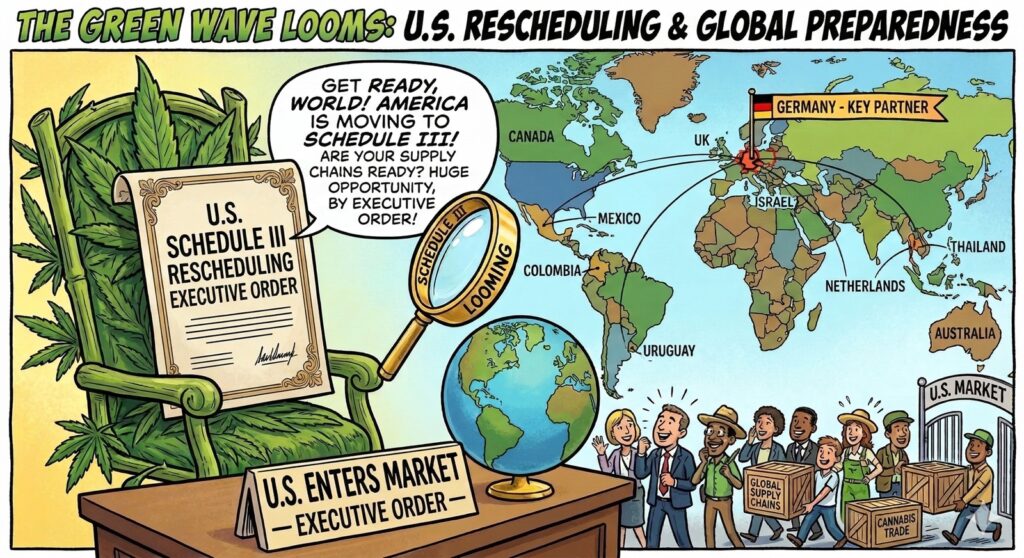
Under a Schedule III framework, U.S. cultivators and manufacturers could obtain federal registrations through the Drug Enforcement Administration and potentially participate in international trade under established controlled-substance rules and treaty obligations. For the first time, federally compliant U.S. operators could legally produce and export medical cannabis within the same regulated frameworks that many international companies already operate under.
For global operators, that shift introduces a new variable into an already complex supply chain. American-produced cannabis could eventually appear on the same pharmacy shelves as established international products in markets such as Germany, Israel, Australia, and others.
The implications are straightforward: the United States could quickly become a meaningful participant in the global cannabis market, and international operators will need to understand how American entrants could influence pricing, supply dynamics, and partnership strategies.
But the opportunity—and the competition—comes with significant complexity.
The global cannabis trade is disciplined, highly regulated, and unforgiving. It operates under pharmaceutical expectations, strict quality systems, and international treaty structures. Operators must demonstrate validated production, robust chain-of-custody controls, and compliance with good manufacturing practices.
Any U.S. operator seeking to participate in international trade under Schedule III will need to meet those same standards. This means GMP+ certification, pharmaceutical-grade facilities, validated logistics systems, and regulatory oversight consistent with controlled-substance frameworks.
For international operators already operating within these standards, this may represent both reassurance and opportunity. In many respects, the global industry has already built the infrastructure that U.S. companies will now need to adopt. Companies that have invested heavily in compliance, validation, and pharmaceutical-grade production are likely to find themselves well-positioned relative to any new entrants.
At the same time, international operators should anticipate a structural divide emerging within the U.S. industry itself.
Some American companies will pursue federal compliance, and are already doing so, by registering as Schedule III entities and operating within other federally regulated frameworks. These companies may interact with other compliant actors, including researchers, pharmaceutical entities, and potentially international license holders operating under equivalent regulatory structures.
Others will continue operating primarily within state-based programs, particularly in adult-use markets that remain outside federal controlled-substance compliance.
Understanding this dual-track system will be critical for international operators evaluating future partnerships, supply agreements, and competitive positioning. Not every U.S. company will operate within the same regulatory framework, and distinguishing between federally compliant operators and purely state-based operators will become increasingly important.
Existing international markets also provide valuable lessons about what may come next.
Canada’s federal legalization created rapid growth but also oversupply, illustrating the risks of scaling production too quickly. Germany’s measured approach to medical cannabis, including insurance reimbursement and physician oversight, demonstrates the value of stable, patient-centered frameworks. Meanwhile, countries such as Colombia and Morocco have developed cultivation-for-export models that leverage climate advantages while maintaining strict regulatory compliance.
Each of these examples offers insights for how global markets evolve—and how the U.S. might enter them.
Strategic preparation will therefore be essential for international operators assessing the impact of U.S. rescheduling. Companies should evaluate how their existing facilities, certifications, and processes align with potential collaboration or competition with U.S. operators. Pharmaceutical-grade production standards, active pharmaceutical ingredient readiness, USP compliance, and compounding frameworks may all become relevant considerations in cross-border partnerships.
Supply quotas, international treaty obligations, and global logistics will also play a significant role in determining how trade develops.
Rescheduling will also influence capital markets. Schedule III compliance could open the door to institutional investment within the United States, introducing well-capitalized American companies into an industry that many international operators helped pioneer. This could intensify competition for partnerships, distribution agreements, and market share.
In this environment, governance, transparency, and operational discipline will become even more important.
Ultimately, the potential rescheduling of cannabis in the United States represents more than a domestic regulatory adjustment. It is a global inflection point.
International operators who are aware of these developments and who proactively evaluate how U.S. participation could affect the global supply chain will be better positioned to adapt, collaborate, and compete.
Those who ignore it may find themselves reacting after the board has already begun to move.
The global cannabis industry has spent the past decade constructing an international framework for trade and regulation. If Schedule III becomes reality, the United States will finally have the ability to participate meaningfully in that system.
And when a market the size of the United States enters the global arena, the chessboard inevitably changes.
The only real question is whether operators around the world are prepared for the next move.
***
Author information:
Website: www.BobHoban.com
CTrust: www.ctrust.io/meet-us/
Forbes: Robert Hoban, Contributor Page
LinkedIn: rhoban
Instagram: bob_hoban
Facebook: bobhoban, Robert.Hoban.Attorney
X: Robert_Hoban
The Hoban Minute Podcast:
Share article